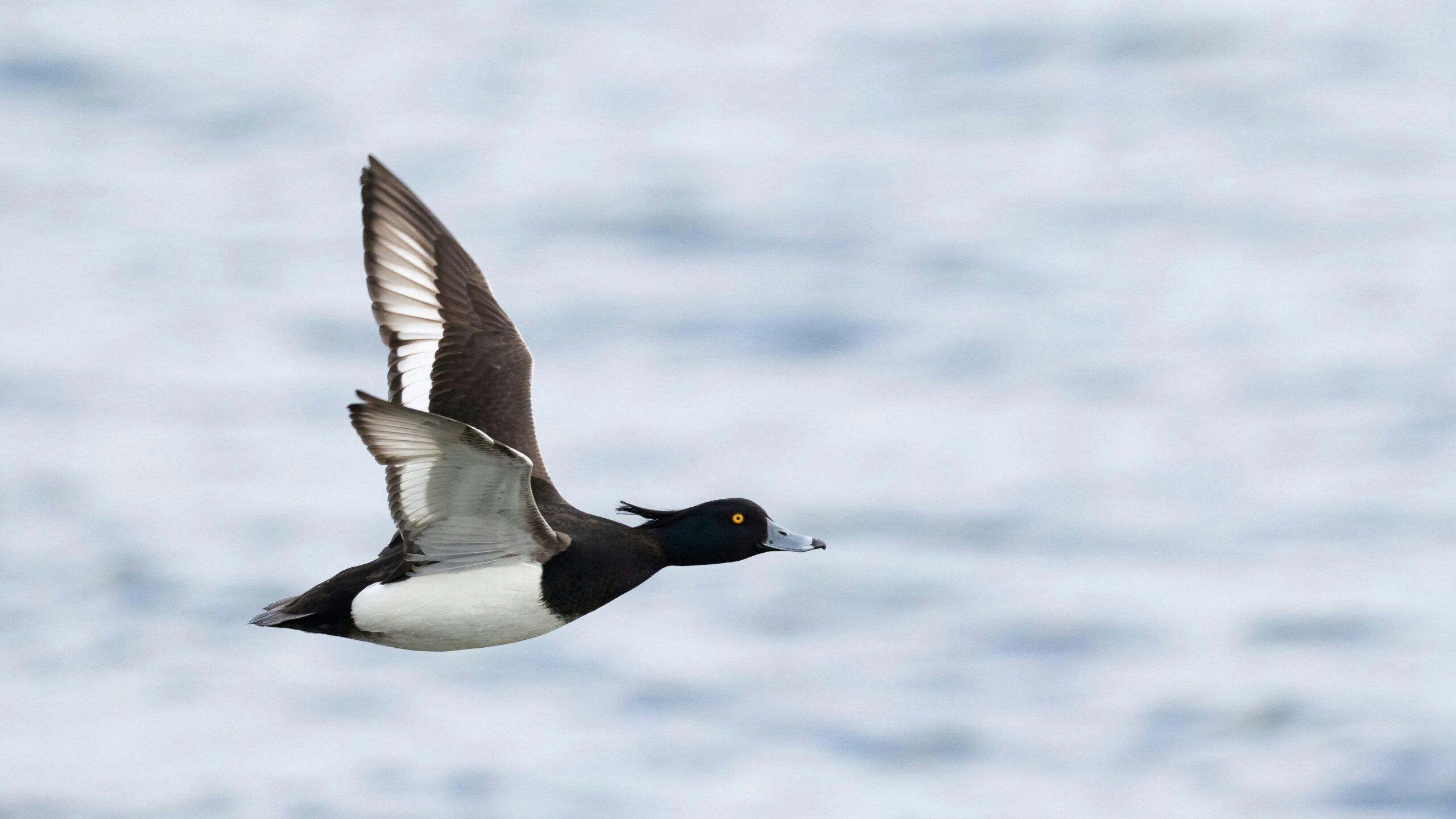
They’re a familiar sight now, but it’s not that long ago they were a rarity…
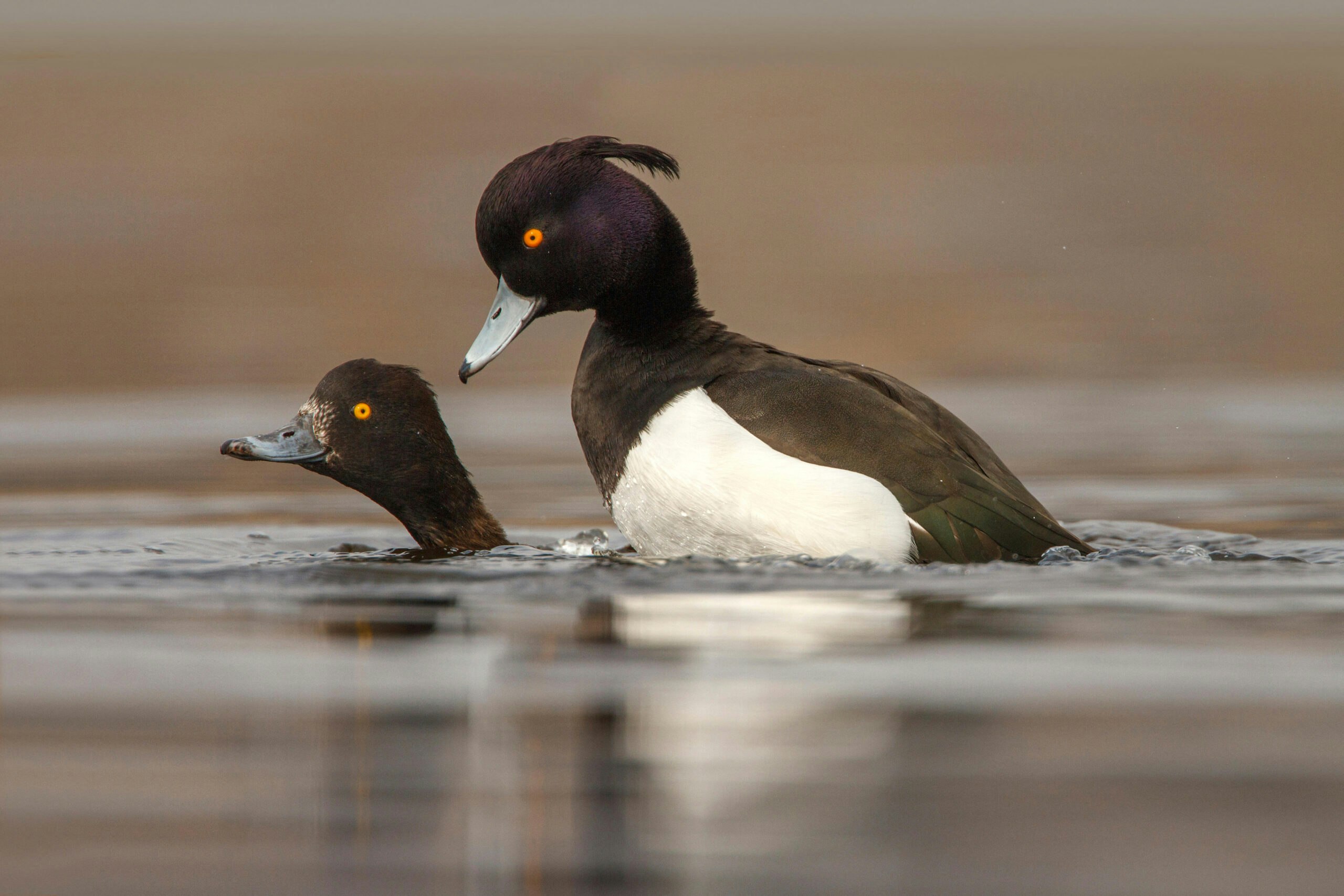
It’s funny how Tufted Ducks remind you of hummingbirds, isn’t it?
You haven’t got the connection? Well, it’s the parallel way that both birds only take a short time to fill their crop and then must wait until they can process food before beginning a new bout of foraging. Of course, you get it now. It sounds arcane but has great significance for both groups of birds.
The time budget is surprisingly similar. The hummingbirds hover at flowers and can only consume so much nectar before they are full and must return to a perch. In the case of Tufted Ducks, they are filling their oesophagus with freshwater mussels, which must be crushed in the gizzard and the meat extracted before any more can be swallowed. This is time consuming for both birds and, in both cases, they need about 10-15 minutes of digestion time before resuming foraging.
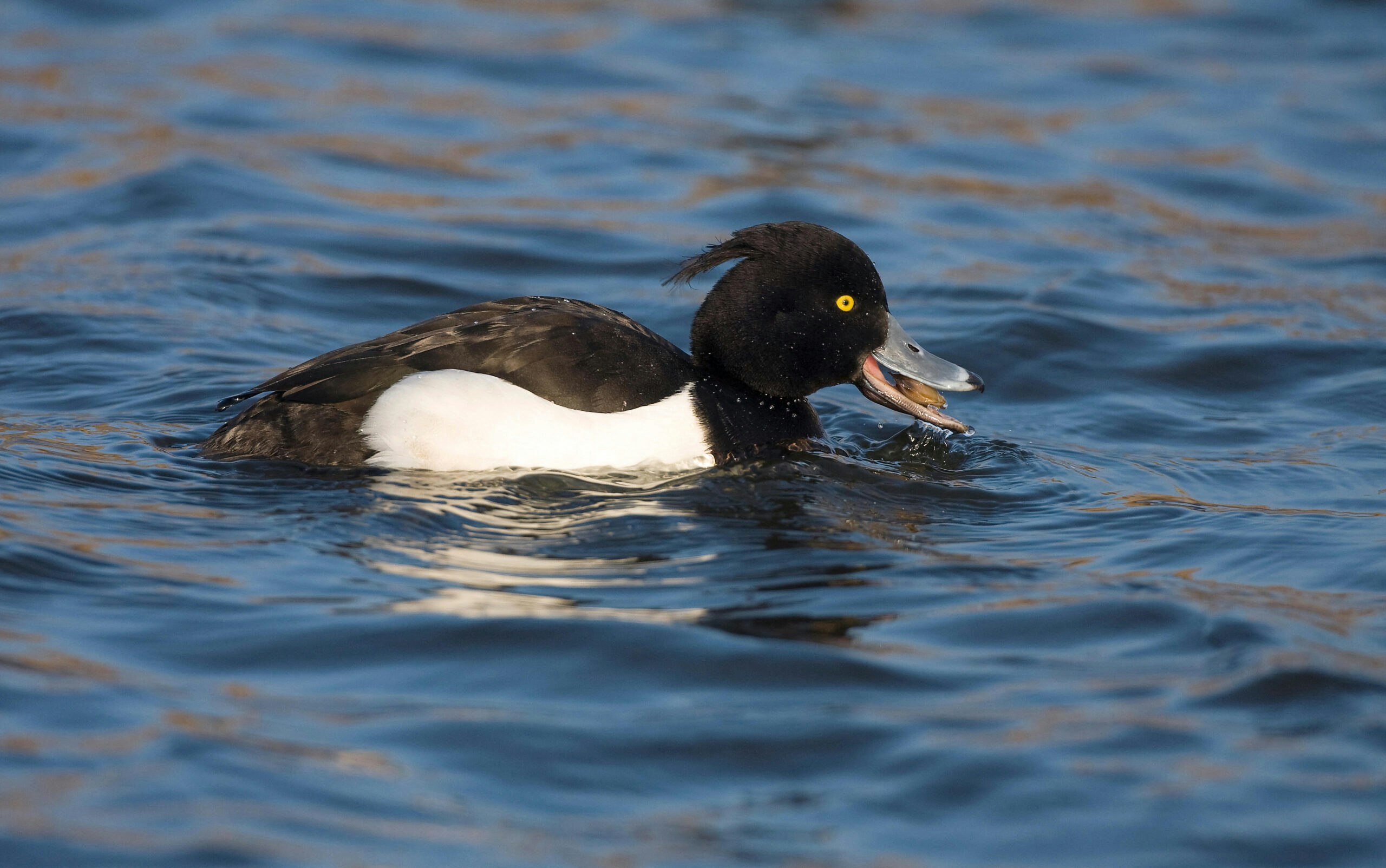
And for the Tufted Duck, the process of foraging is also notably hard work. It must submerge beneath the surface of the water, dive to the bottom and snatch shellfish and other foodstuffs before coming back up for air. It has no particular adaptations to reduce buoyancy but will often perform a small leap before immersing head-first. It will typically make a series of dives, each lasting no more than 20 seconds, and then take a break. It can only store a maximum of 5% of its daily requirement of food in its gut at any one time, meaning that it usually has to spend inordinate amounts of time replenishing. On a winter’s day, a Tufted Duck will spend 61% of the daylight hours feeding and use up 50% of its available energy. At the same time, it must consume up to three times its own body mass.
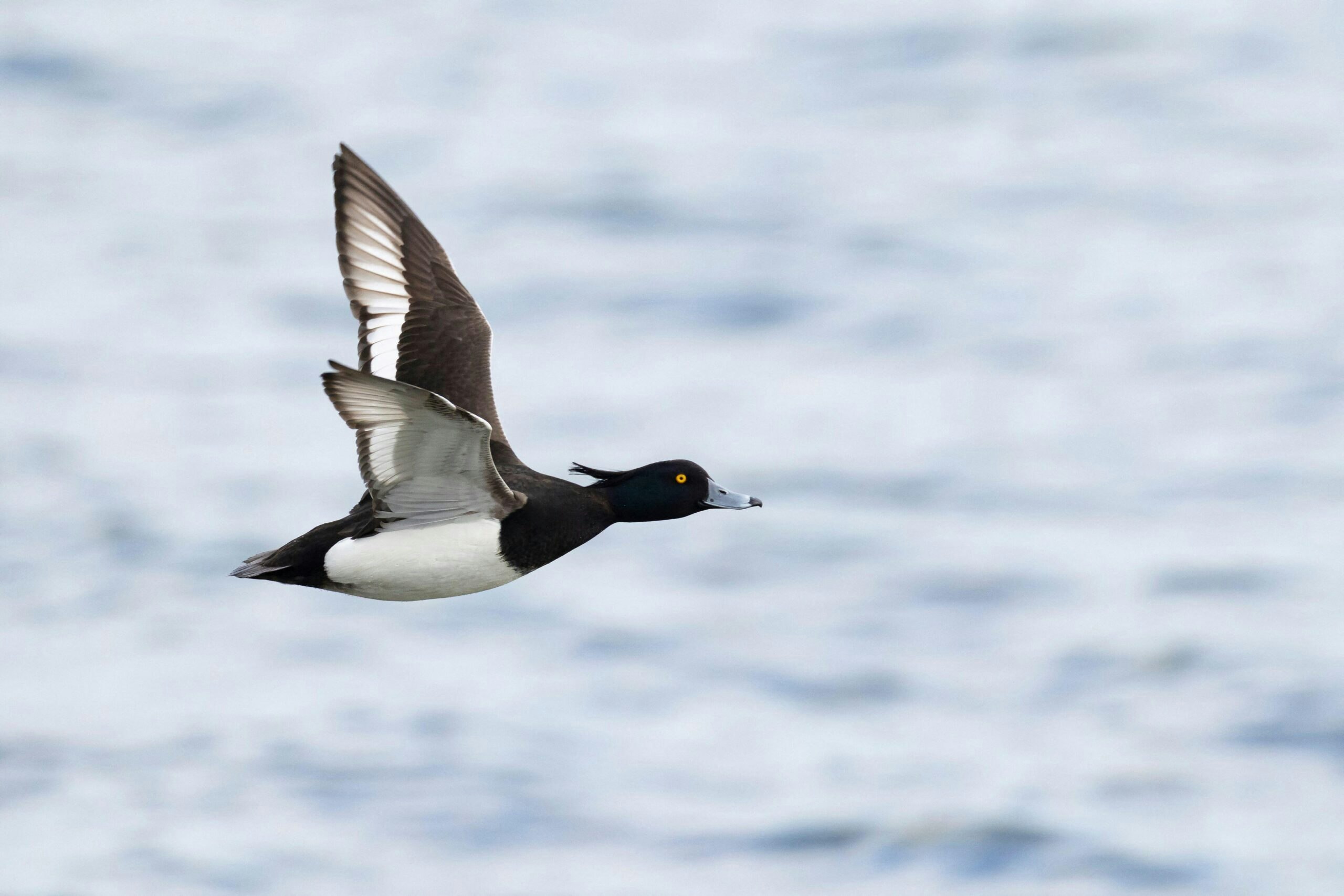
Watching Tufted Ducks serenely swimming and dipping on a park lake, it is hard to believe that they have such a busy schedule – they really are paddling hard under the surface!
The Tufted Duck is, to most people, the most familiar of our ‘professional’ diving ducks, those for whom total submersion is their primary foraging method. The Eider is more numerous as a breeding bird (37,000 pairs), but the Tufted Duck (c.17,000 pairs) is the one we see on park lakes, gravel pits and other freshwater habitats, often showing considerable tolerance towards people. It sometimes mixes in with Mallards taking grain thrown by park visitors, but it otherwise submerges to feed. It rarely occurs in water that isn’t at least two metres deep.
It is a small, rather neat duck, and the male has a pert crest and all-over glossy black plumage relieved only by a blazing white side-panel. The female is sooty-brown, with the white on the side-panel replaced by a paler shade of brown. Both sexes have a blazing yellow eye. As with all diving ducks, which have back-set feet to propel them under water, the Tufted Duck must take a run-up to become airborne, and it has very fast wingbeats and shows off a broad white wing-bar.
The Tufted Duck is such a staple of our birding life that few people are aware that it was once a great rarity. There were no confirmed records of it breeding here until 1849, when it nested in Yorkshire, and then again in 1851 when it colonised Nottinghamshire. These nesting attempts were the subject of great excitement in the ornithological community at the time, but by the end of the 19th Century the Tufted Duck had established a firm foothold. Although its increase was slow until the 1960s, it accelerated greatly by the time the lowlands of Britain became studded with gravel pits, reservoirs, lakes and other freshwater sites during the 20th Century.
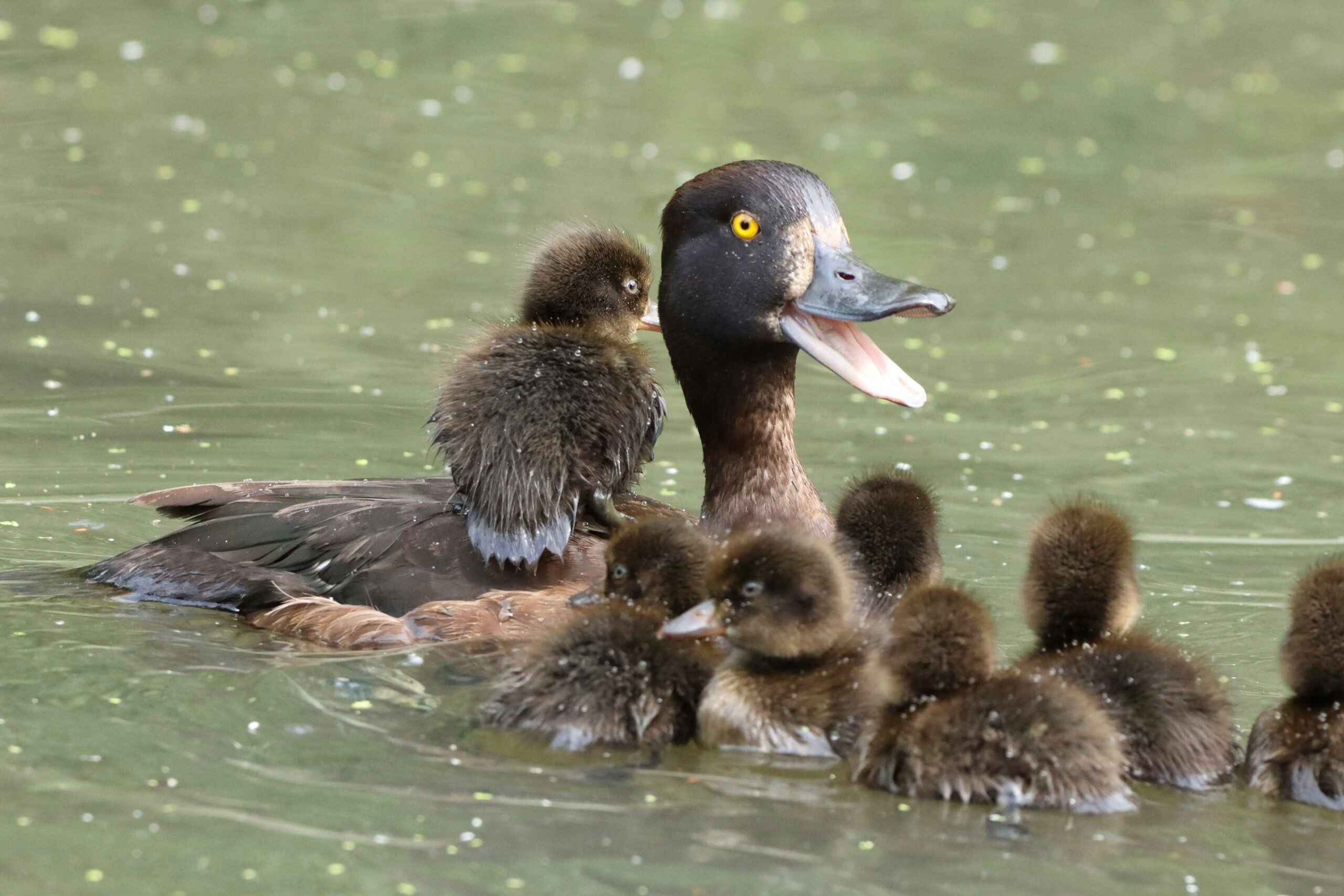
Tufted Ducks are very late breeders, and it is rarely until late June or even July before their broods of fluffy, ‘floating bumblebee’ young appear on inland waters. The young are sooty brown all over, without the red colours you see on similar sized Moorhen and Coot chicks and, unlike those two, Tufted Ducklings feed themselves by diving in the same way as the parents. These mites are very appealing and, if you’ve never seen a brood of these birds, you are in for a treat.
These birds preferentially breed on islands within lakes. Their nests can be quite close together, as little as 7m, which may give the impression that they are colonial, although they aren’t. However, this proximity does give birds a chance to be sneaky. It seems that females quite regularly lay their eggs in the nests of neighbours, which is a stress-free way of increasing productivity at the expense of acquaintances’ effort. This intra-specific brood parasitism, also known as egg-dumping, is quite a common practice among diving ducks. These birds often lay quite large clutches – 8-11 is the normal range – so one can easily imagine a female losing count of her genuine progeny.
Tufted Duck migration is a distinctly complicated affair. Many males, but not all, leave the breeding areas to go to larger lakes to moult, leaving the females with the chicks. Most females moult on the breeding lakes. Most Tufted Ducks in England, if they migrate at all, make small movements to winter in different parts of the country, while many Scottish birds move to Ireland. To complicate matters further, some northern European birds, including those anywhere between Iceland and Russia, winter in Britain or further south. Most unusually, though, there is evidence that same-sex siblings within broods sometimes travel on migration and winter in the same places. To cap all these complications, males and females often pair up in winter flocks and, in common with other duck species, these pairs typically return the next season to the female’s natal area. Hopefully, this has made everything crystal clear.
What is particularly interesting about the Tufted Duck’s spread was that it appeared to have a specific type of rocket fuel. In 1824, the Zebra Mussel was accidentally introduced into London’s docklands, probably on ships coming from the Black Sea, perhaps in ballast water. The mussel soon spread considerably and, since it is one of the Tufted Duck’s favourite food items, this undoubtedly helped the duck to expand in kind. Even today, it is a staple food of adults, although they also eat other molluscs, crustaceans and also, in some locations, plant material. But the relationship between the Zebra Mussel and the Tufted Duck is black-and-white.
On a broader level, the Tufted Duck can also be a long-distance migrant. Some birds from western Siberia winter in Africa, going as far south as Ethiopia, while many other Siberian birds go to India or south-east Asia. Stragglers have reached some truly bizarre outposts, including Malawi, the Seychelles, Papua New Guinea and even Hawaii.
Despite its wide distribution, reaching right across Eurasia to eastern Russia as far as Kamchatka, the Tufted Duck has never successfully colonised North America, unlike many of the British ducks. The existence of the Lesser Scaup, a smaller relative of our own Greater Scaup, has probably lessened its scope, even though the Zebra Mussel is also now colonising the New World.
Perhaps it will one day. And if that happens, then we will be able to observe the feeding regimes of Tufties and hummingbirds in the same place.
Species Factfile
TUFTED DUCK
Scientific name: Aythya fuliflia
Length: 40-47cm
Wingspan: 67-73cm
UK numbers: 16,500-19,000 breeding pairs; 140,000 wintering birds
Habitat: Urban, suburban, marine, intertidal, wetland
Diet: Molluscs, insects, plants
Fun fact: There were no confirmed records of it breeding here until 1849, when it nested in Yorkshire, and then again in 1851 when it colonised Nottinghamshire