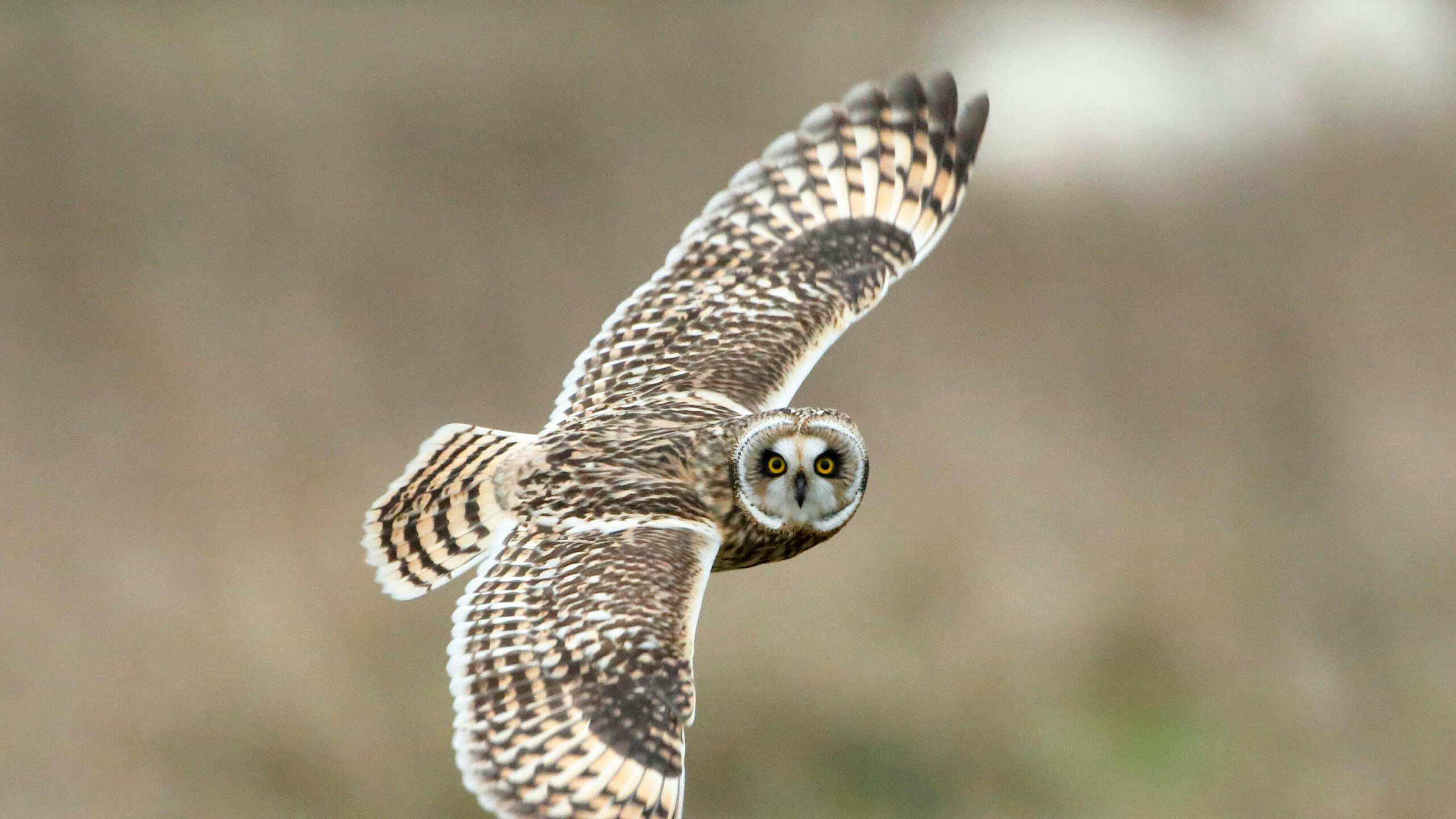
This is a hunter from which you can expect the unexpected
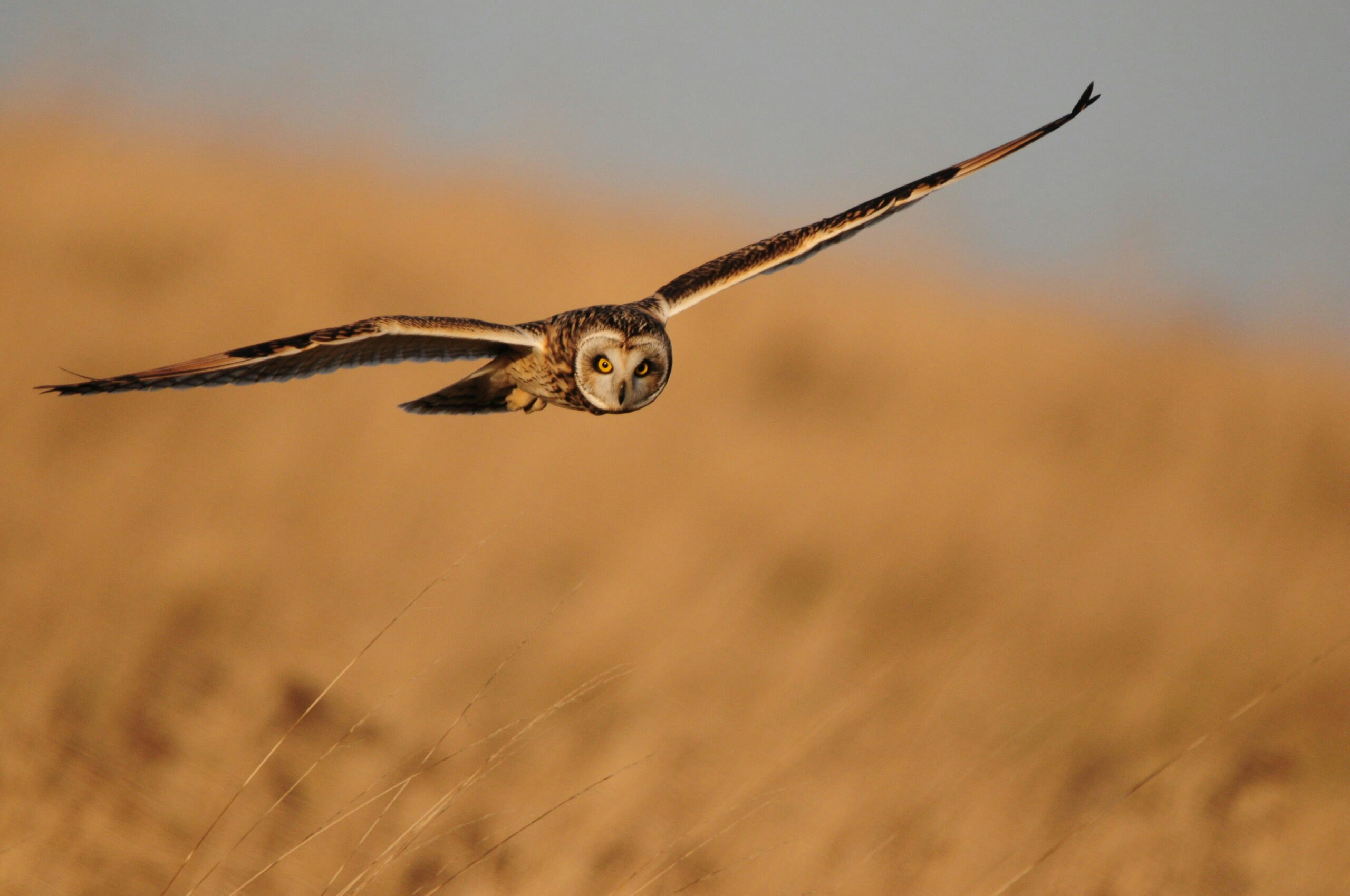
It was the incongruity I remember most. I was on a North Sea ferry, crossing back to the UK on a late September morning. Typically for any birder, I was out on deck, binoculars at the ready, waiting for seabirds to appear. They did, too, a decent roll-call of auks, gulls and Gannets. But then, out of a patch of mist, came something entirely different, a large, brown bird with wavering flight, which I instantly realised was an owl. It was a Short-eared Owl, bobbing over the sea instead of grassland or moorland, a peculiar and unexpected sight.

However, much as the idea of an owl over the ocean waves is unusual to us, the Short-eared Owl has considerable form as a seafarer. It has been seen in similar vein on vessels as far out as 1,000km from land. Still more impressive evidence for these qualities comes from the Short-eared Owl’s amazing appearance on islands far offshore. It breeds, extraordinarily, on the Galápagos Islands, 1,000km out in the Pacific and, even more impressively, on Hawaii. The birds on Hawaii are thought to have come from Alaska, which is almost 5,000km away. So, a modest sea crossing between Scandinavia and the UK should be well within this amazing animal’s compass.
This is not, though, an owl that does things the typical family way. For one thing, it isn’t a confirmed night-owl – far from it. It routinely hunts during the day, and there is some evidence that its activity pattern is weighted towards the afternoon. On most days, it can satisfy its needs by a couple of decent meals a day. It has several other interesting quirks, too, as we shall see.
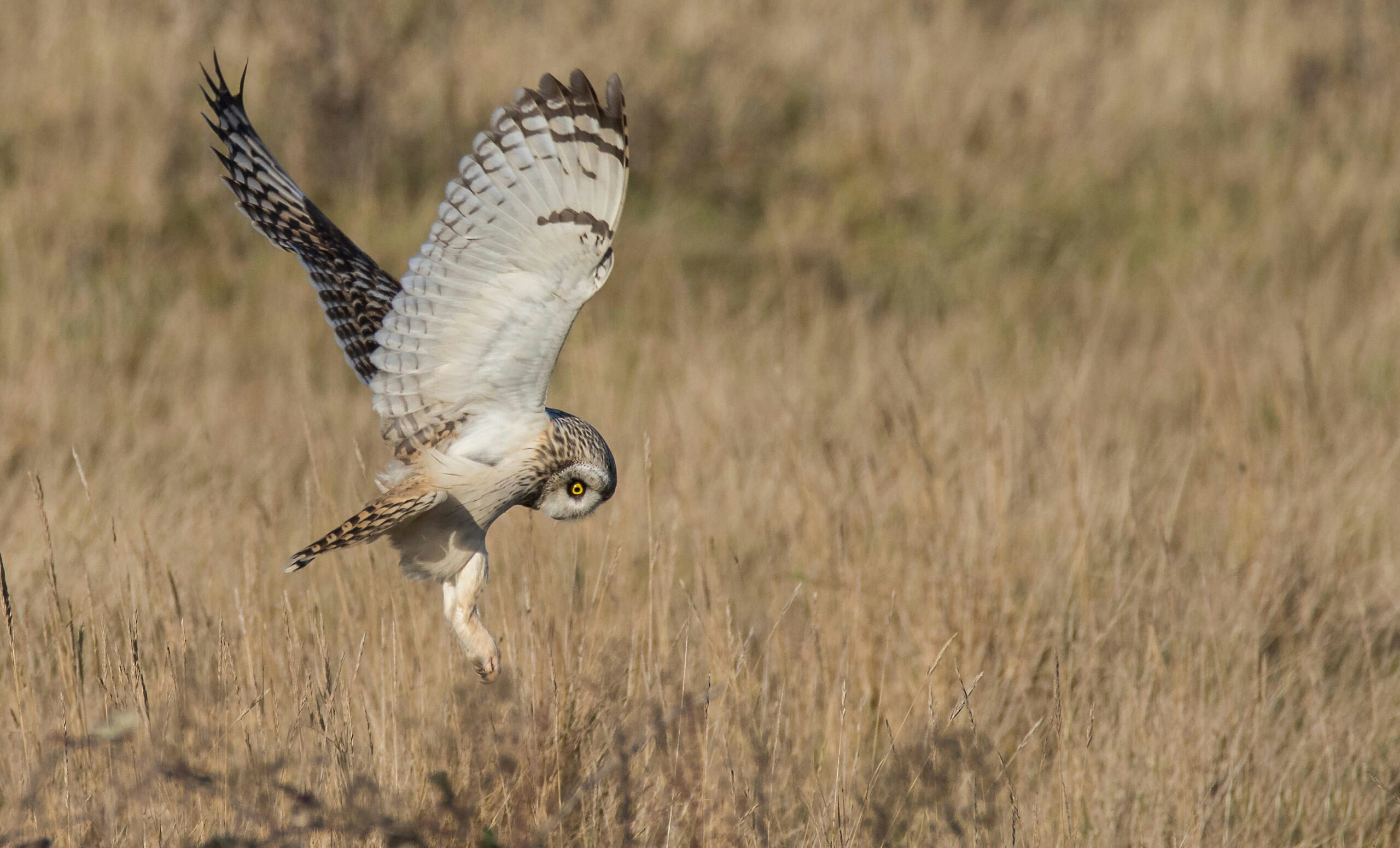
But there is a fundamental about Short-eared Owls that you must know; their lives revolve around voles, the key prey species. Voles are small mammals famous for two things: they cannot stop peeing (they must go at least 20 times a day), and they have cyclical population numbers, often with three years of build-up to a boom followed by a bust. Short-eared Owls, if they want to succeed in life, follow the voles.
This owl’s method of hunting is very distinctive and ideally suited to working through the hiding places of our main grassland rodent, the Short-tailed Vole. It catches most of its prey while foraging in flight (unlike the Tawny Owl and Little Owl, which are primarily perch hunters), using its broad, rounded wings to keep it floating buoyantly just above the ground. Possessing very soft feathers that dampen the sound of its approach, the owl can creep up from above upon rodents quite unaware of the danger overhead (voles’ horizons don’t stretch much beyond the next bit of nibbled grass). A quick dive, talons-first, and they grasp the prey. Curiously, Short-eared Owls aren’t very keen on heads, which they snip off with the bill, often eviscerating the unfortunate mammal and concentrating on its muscles. On the occasions when Short-eared Owls eat birds, which they do quite often (see below), they also remove the head.
In common with all owls, Shorties use a battery of sensory expertise to home in on the prey. They certainly use sight, and the olfactory lobe is large in owls, so it is perfectly possible that they can use scent as well. However, hearing undoubtedly plays a large part, aided by their quiet approach flight. In common with Barn Owls – and probably most other owl species – Short-eared Owls have asymmetrical ear openings, with the left ear being slightly higher up in the skull than the right ear. Any directional detection of sound depends on waves reaching one ear fractionally sooner than the other. We humans, as well as owls, can determine direction in the horizontal plane in this way – a sound coming from the right reaches the right ear first. For a Short-eared Owl, however, any sound coming from above will naturally reach the left ear before the right ear, adding a vertical component to the owl’s directional sense. This three-dimensional hearing allows the bird to detect sound, especially squeaks and rustles at about 6kHz, with amazing accuracy.
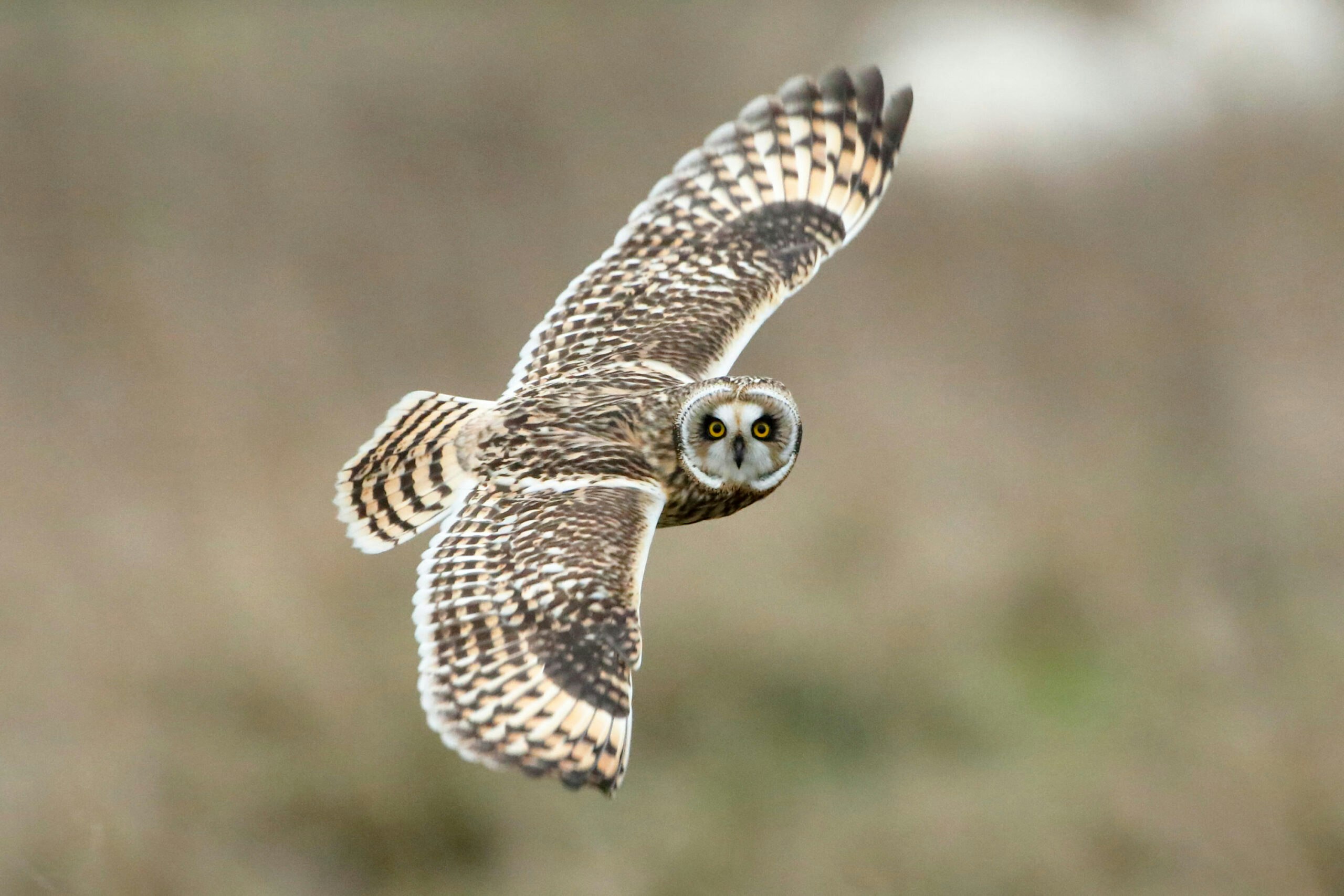
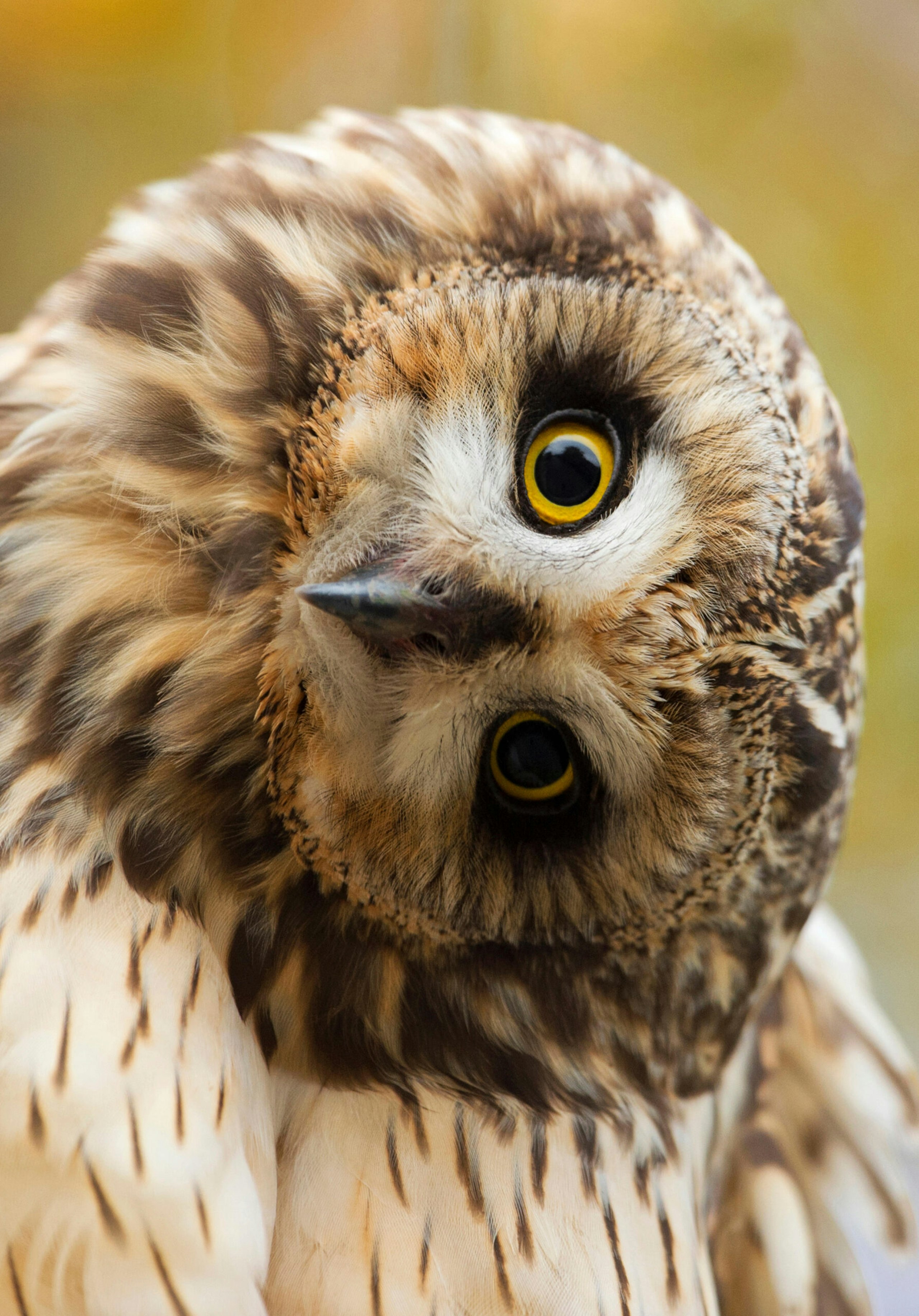
Despite the name, one thing this species doesn’t have is short ears. The real ears are hidden below the feathers, and the ‘ears’ of this bird are merely tufts. They don’t amount to much and you usually cannot see them in the field.
In some years, in Scandinavia, a high population of owls in autumn coincides with a bust in vole numbers, and when this happens large numbers of hungry owls move south from their core breeding areas, and many spill into Britain, and are suddenly widespread – voles to Shorties are like berries to Waxwings. In other years, many fewer visit our country, and you can never tell what sort of winter it will be. But on occasion, there will be many, all over the place, and these individuals often gather at communal roosts in the colder months. Up to 20 may hunker down, usually on the ground, at a single location.
Short-eared Owls do breed in Britain, too, with a population estimated at c.600-1,200 pairs, mainly in uplands, both on open moors and in young conifer plantations. However, these birds have the same vole-oriented behaviour as their Scandinavian colleagues, with their success depending entirely on the population of rodents. If things are furry good, so to speak, they might lay seven eggs in a clutch, and apparently may even attempt to breed more than once in a season, each clutch at a completely different location.
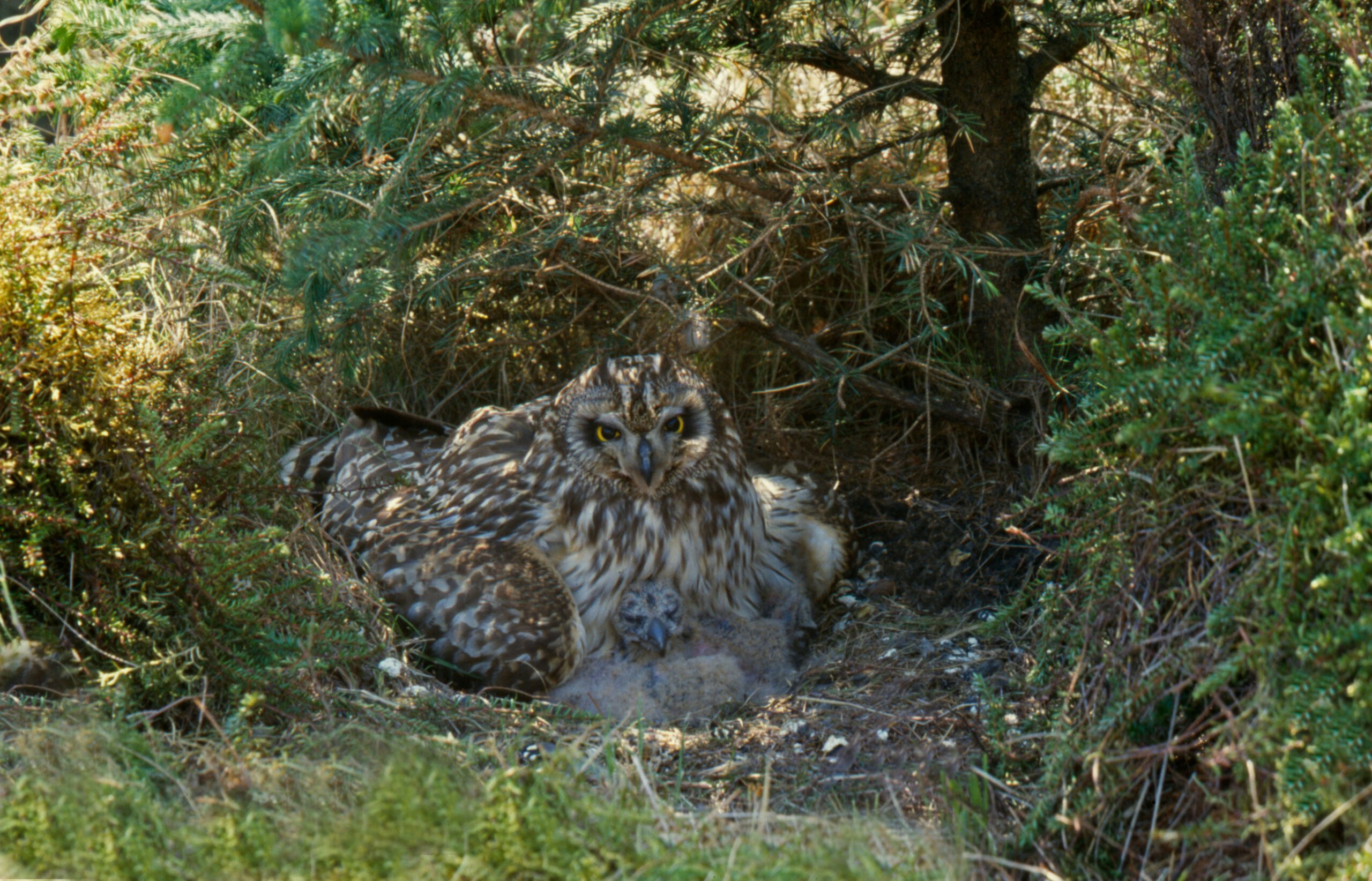
The Short-eared Owl exhibits a couple of interesting breeding quirks. The first is that it often makes a recognisable nest. It isn’t much, just a platform of grass trampled down and with limited amounts of grass and feathers added for lining, but it’s a great deal more than most owl species do. Most just use a cavity, or the nest of another bird, adding nothing at all. But Short-eared Owls are different. They are also fairly unusual in nesting on the ground.
Ground nesting adds another intriguing behaviour, which is known as pre-fledging dispersal. This means that the owlets leave the nest well before they are able to fly, and scatter widely – some may be 50m away from their siblings. There are a couple of reasons why they might do this. Firstly, if a predator finds a youngster, it cannot necessarily find the rest easily, making total brood loss less likely. Another potential reason is to prevent siblicide cannibalism. A female Short-eared Owl begins incubation with the first egg, but lays only one egg a day, so the youngest in a brood may be a week or more younger than their siblings, and consequently much smaller and weaker. The dispersal could lessen the chance of this happening.
As mentioned previously, Short-eared Owls do routinely eat birds, if not their own siblings! The voles are king in most populations, but some individuals, especially those that breed near the coast, eat a lot of birds, especially at their colonies. A wide range of species have been recorded, especially gulls and terns. In true Galápagos style, everything is somewhat different there; on Genovesa, the local Shorties feed mainly on Wedge-rumped Storm-Petrels at their colonies in cracks in the lava. The petrels are the only members of their family that come to their burrows in daylight, and it’s during daylight that the owls hunt them.
As far as is known, though, Short-eared Owls don’t eat seabirds during their migratory flights over the North Sea, so the nearby birds were safe from my owl travelling in the mist. But never write off a Short-eared Owl doing the unexpected.
Factfile
SHORT-EARED OWL
Scientific name: Asio flammeus
Length: 34-42cm
Wingspan: 90-105cm
UK numbers: 620-2,180 breeding pairs
Habitat: Uplands and grassland breeding, lowland grassland and wetlands in winter
Diet: Small mammals, especially voles