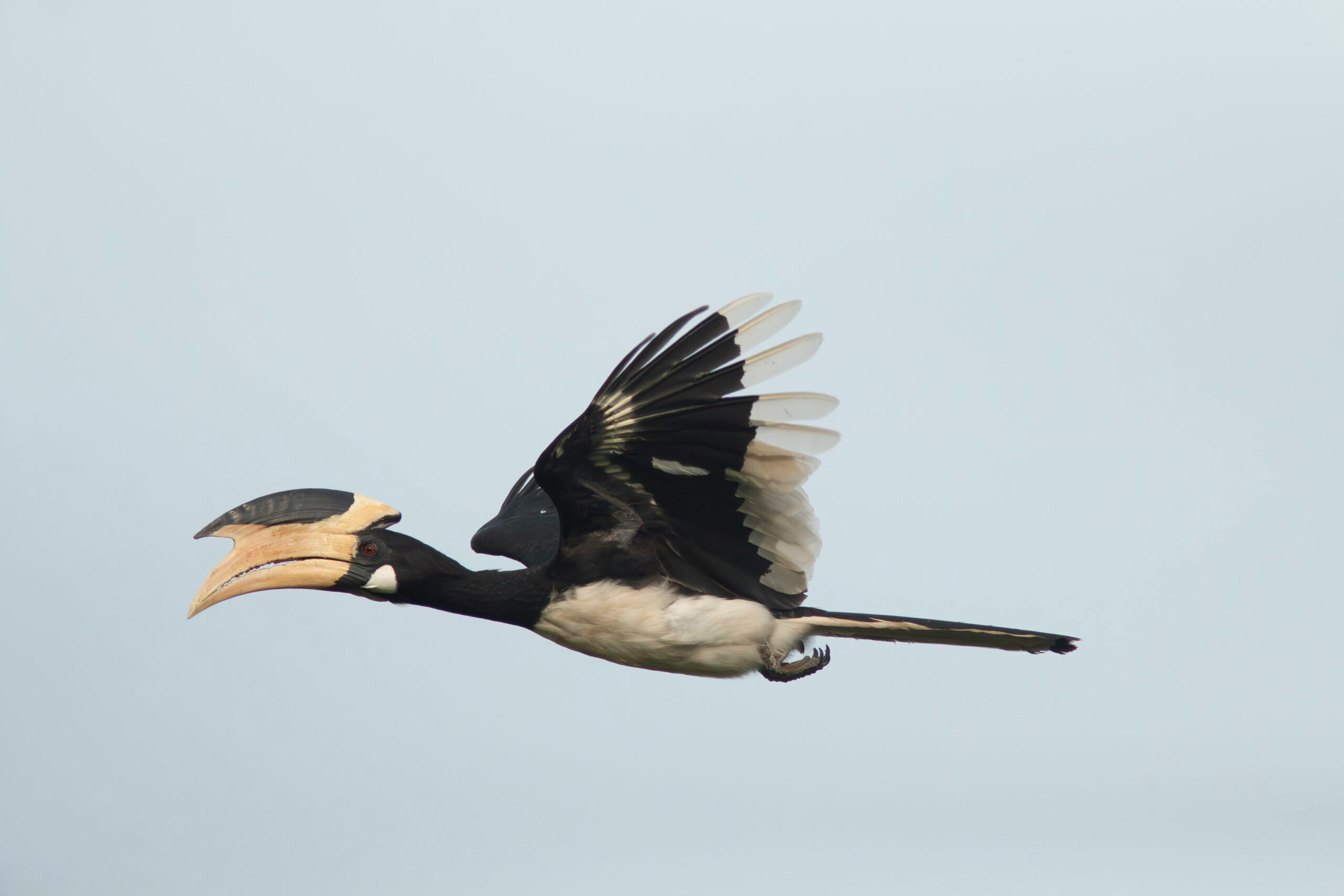
Mike found himself enjoying a familiar scene on a warm evening, when he was rudely awakened from his trance...
It was a lovely, warm, still, spring evening and gazing out over the mill-pond waters of Deeping Lakes LWT, I fell into a dream-like state. A Kingfisher to my left stared at the crystal waters for a sign of movement, while near it, a warbler – a Chiffchaff, perhaps – was fidgeting on the fenceline. To my right, I was aware of a Robin hopping up into a small tree as a pair of Little Grebes swam across my gaze, while a couple of terns patrolled up and down, and a distant swan lazily crossed the lake. A Cuckoo repeated its familiar call, accompanied by the constant ‘kik’ calls from an agitated Great Spotted Woodpecker, while a couple of Moorhens noisily did battle in reed-fringed edge of the water to my right.
I looked up to see our local celebrity ibises flying over the water, and near them a procession of Cormorants flew off to roost, followed by a group of herons. With the sun close to the horizon, the setting became serene and calm. Something bright caught my eye, the first Yellow Wagtail of spring, perhaps, and I was just about to give it more attention when the peace was rudely ruined by the whirring of helicopter blades, low above my head, shattering my reverie.
Suddenly woken from my gentle trance, I remembered where I was, and it was a long way from Deeping Lakes. I was in in the central lowlands, Sri Lanka, overlooking an ancient manmade lake (‘tank’) called Dunuvila Wewa, near Wasmamuwa. I had just arrived after a long drive from the hill country of the south (no driving by me, you understand – the Sri Lankan traffic seems insane, but everyone seems to understand the system, and the roads were remarkable peaceful!), and just settling in to a new set of conditions, a new set of birds. The hunting Kingfisher was the same glorious little species we have here, though it was soon joined by a much larger White-throated Kingfisher. The little warbler was actually a Plain Prinia, and the ‘Robin’ was a black male Indian Robin.
I have clearly spent too long at Deeping Lakes, this spring, and the familiarity of Little Grebes kicked started my mind drifting back there. But, a closer look revealed that these Little Grebes had yellow (not dark) eyes of the central and south Asian subspecies, and the terns were Whiskered Terns. Even the ‘swan’ was not what it seemed, but really a slow-swimming Spot-billed Pelican. What I imagined were the ‘kik’ calls of a woodpecker were actually the persistent, interminable and ubiquitous angry calls of the abundant little Indian Palm Squirrels, while the Cuckoo call was indeed a cuckoo, but the species was Asian Koel, and to say its ‘koel’ sounds like our Cuckoo is pushing it more than somewhat.
It is also pushing it to say the appalling racket of somewhat Moorhen-like White-breasted Waterhens in any way resembles even the angriest sounds of our Moorhens, but please allow for my hazy, detached state.
The ibises were not south Lincs’ famous trio rare Glossy Ibises, but a V of 100s of Black-necked Ibises (which look like sacred ibises) heading off to roost, and the ‘Cormorants’ were diminutive Little Cormorants, the herons Indian Pond Herons, skeins of them.
The bright yellow bird which caught my eye was not a wagtail, but a glorious Black-hooded Oriole, which flew up into a tall tree allowing the setting sun to reflect golden fire in its wonderful plumage.
And, in case you were wondering, the whirring helicopter blades which brought me to my senses, were the whooshing wings of Malabar Pied Hornbills gathering from the surrounding countryside to roost at the lakeside. First one bird almost made me duck with the unexpected loud sound from above; then another couple, followed by half a dozen more – all heading to tall tree overhanging the lake. Eventually, soon after the sun disappeared, a total of 40 or so of these massive toucan-like monsters came overhead and filled up the tree.
It was a wonderful experience watching the hornbills gather, and chatter and peck each other in pairs, before crossing the little bay in front of me to some more trees to settle for the night. In fact, that early evening by the lakeside had been a great, gentle introduction to the birds of the region, before the next day taking an early jeep safari out to Wasgamuwa National Park, where the overwhelming number of new birds had my head reeling. A little touch of the familiar before the rush of the strange.